
The Divine Generals
Exploring Lantau Island, Hong Kong

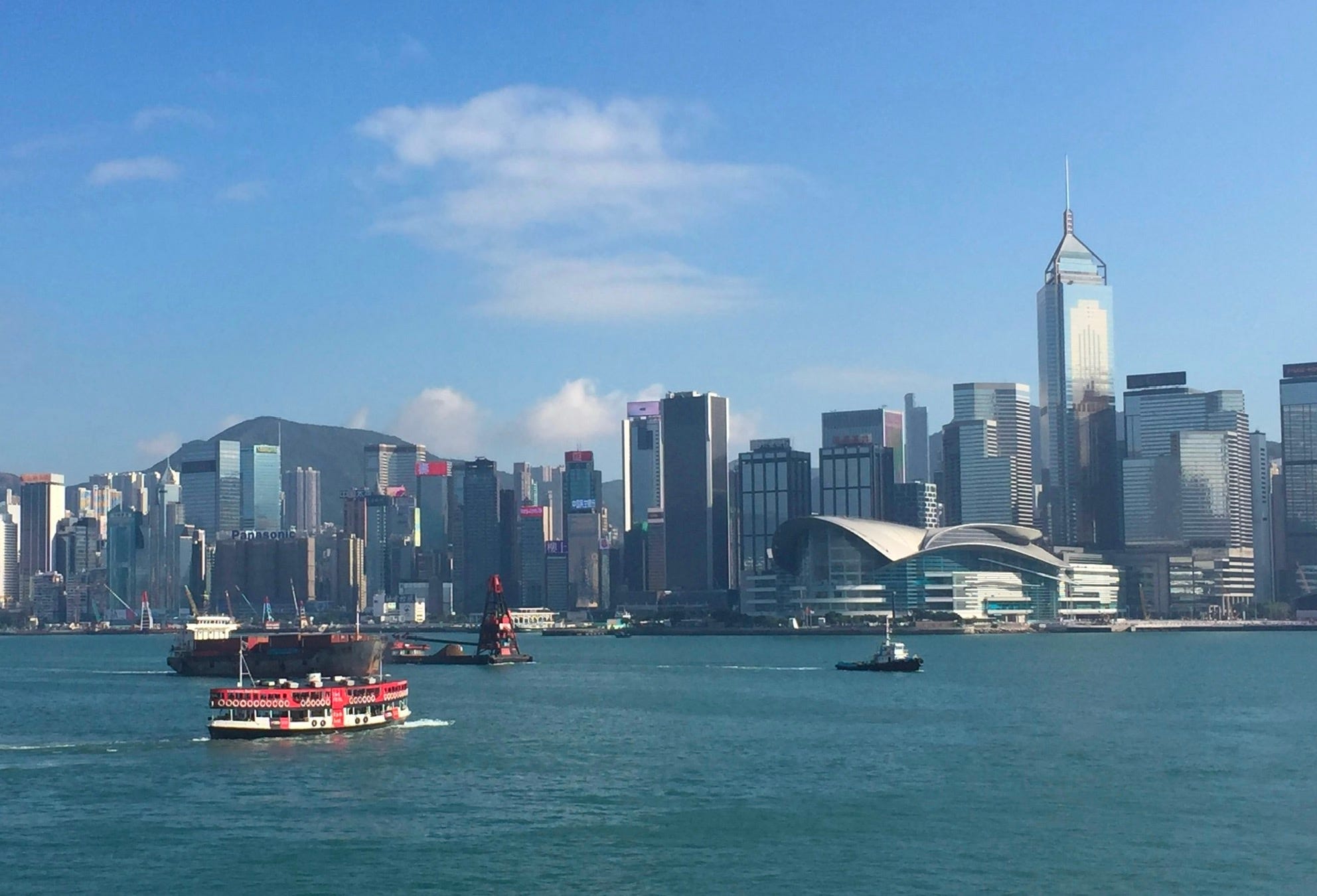
Of all the time I have spent in this city, I don’t believe I’ve ever seen it as clear as this morning.
A hundred miles from the airport, reports tell us the sky is clear, the visibility is good, but those are only numbers. I cannot yet see the light for myself. We’re busy, briefing the planned approach, reviewing charted altitudes, and anticipating airspeeds. Checklists follow, and controllers soon begin sequencing our arrival.
We’re pilots, trained to anticipate every scenario. Yet, on a clear morning when the weather is good, there’s always room for a moment or two of magic tucked between procedures and instructions.
At 5:30 a.m., with minutes left in our fourteen-hour flight, we found it.
It appears as light, descending through five thousand feet, the first shimmer of dawn. Heading south, a few miles from our final turn toward the runway, I can see the airport to my right, awash in a series of familiar lights. The surrounding darkness emphasizes that this airport is on an island, framed by inky water, with only faint outlines of mountains and scattered lights beyond.
Moments later, a faint pink light begins to emerge, a quiet sunrise blush highlighting the silhouette of Lantau Peak. To our left, we are surprised to notice that, as the light spreads, we can suddenly see all the way to Macau. We’ve all flown here numerous times, yet none of us could remember ever seeing it so clearly.
After landing, on the drive to the hotel, I watch the city continue to brighten with the morning sun. Hong Kong is always beautiful. But today, the air feels so fresh, the light is luminous, and the clarity with which it highlights every detail turns a beautiful city into one that is breathtaking.
Suddenly, I’m seized with a desire to be everywhere at once: forested peaks, my favorite temples, new sights. I want to see every bit of this city basking in glorious light.
Which immediately brought a particular site to mind: Lantau Island, home to the Tian Tan Buddha, with “tian tan” meaning Altar of Heaven.
Lantau is a large, mountainous island, mostly rural and heavily forested, located to the west of Hong Kong Island. Surrounded by peaks rising over two thousand feet, at the heart of the island is a plateau called Ngong Ping, far removed from the small fishing villages that dot the coastline.
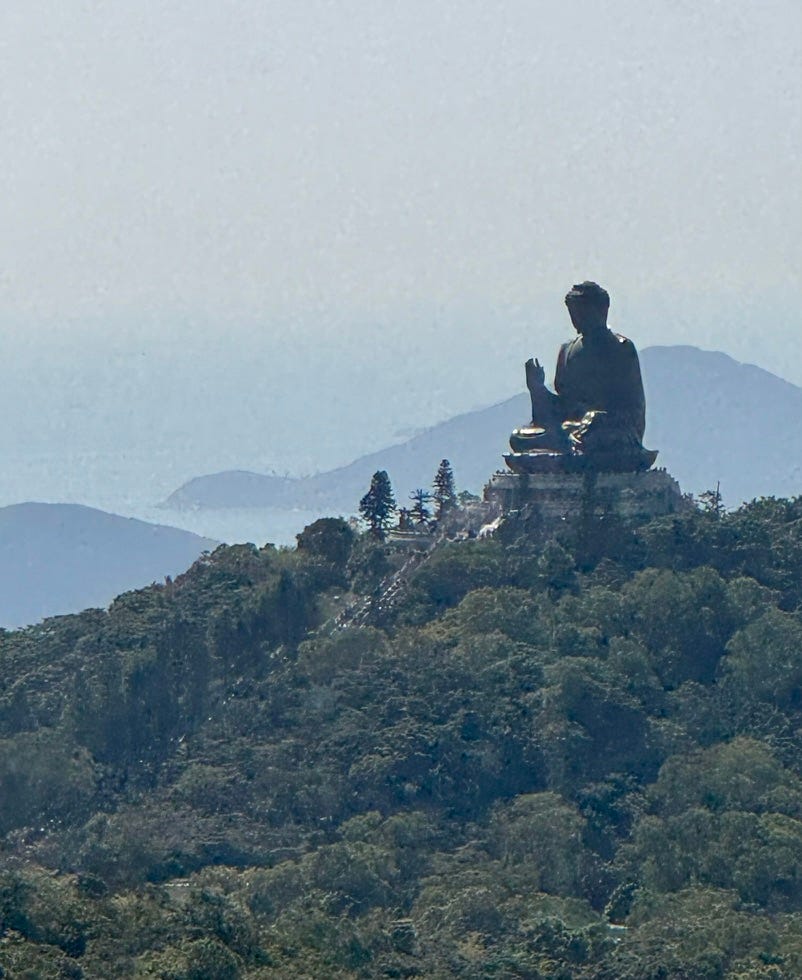
Although the island has undergone development in recent years, the plateau has a sacred history. In 1906, three monks from mainland China arrived in this remote area, establishing “The Big Thatched Hut,” which later grew into Po Lin Monastery. As the site evolved into a pilgrimage destination, plans were made to construct a large bronze Buddha statue on the hilltop, a location that would captivate pilgrims and travelers for generations.
I had sought out this ten-story-high Buddha on a previous trip to Hong Kong. At that time, however, the city was blanketed in a heavy layer of fog. Cold and mysterious, it wrapped everything in a veil, making it almost impossible to grasp the scope of the towering peaks, the gondola ride, or even the Buddha itself.
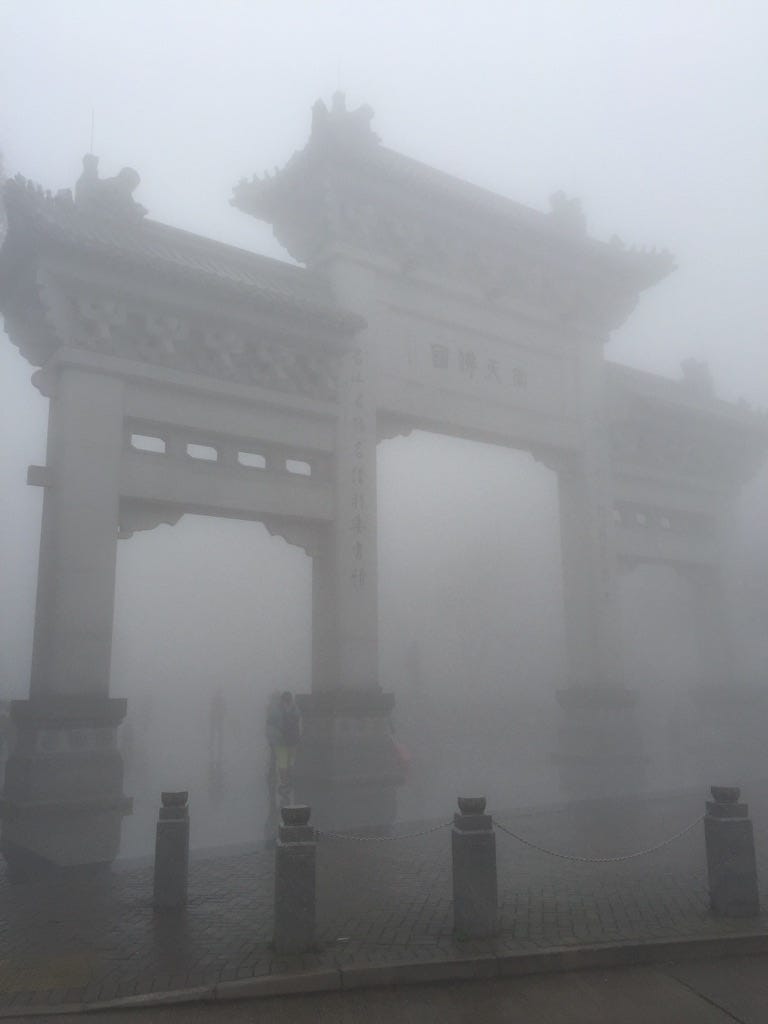
When I arrived on the plateau that day, the thick fog and drizzle made it hard to see more than a few feet. With only a water-soaked paper map, my travel companion and I made our way carefully across the wet stones, passing under an archway that loomed in the dense fog.
Suddenly, a figure took shape; towering, fierce, its frozen expression carved in stone. Eyes fixed, sword raised, it commanded the path and issued a silent warning before dissolving back into the mist. As we moved forward cautiously, another materialized, sudden and forceful, to take its place. Who were these ghostly figures? It was unclear how many there were, but with each step, a different warrior emerged. Confronting us wordlessly, they seemed to grant passage before vanishing once more into the shifting fog.
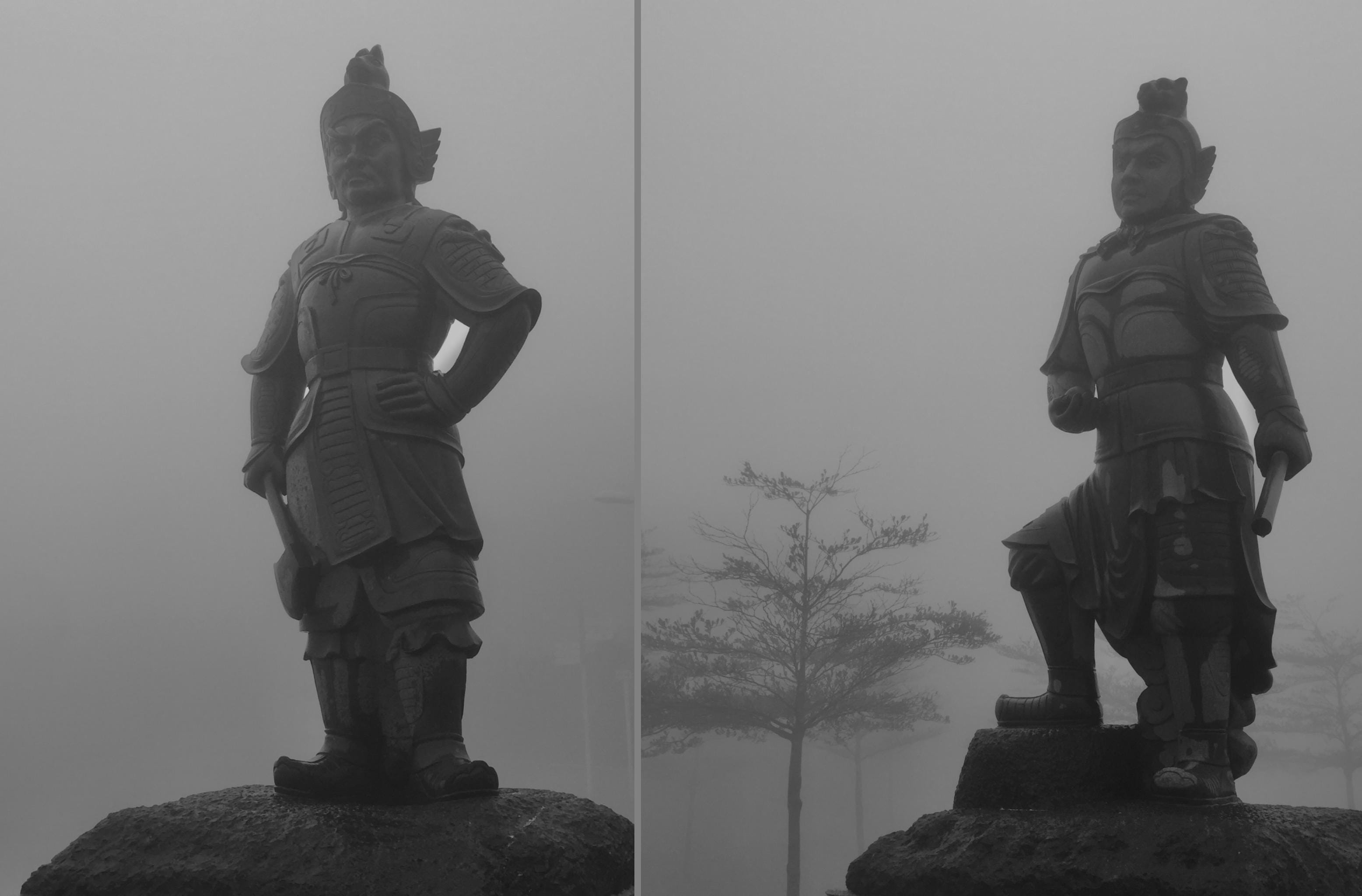
I was both enchanted and intimidated, surrounded by the haunting silence and the gentle, muffled rhythm of drizzle against my hooded jacket.
A cow appeared. Emerging from the mist, it took a moment to realize this was a living creature. A guide, perhaps, or simply another traveler seeking the path? Pausing in front of me, we exchanged a silent greeting. Upon realizing I had neither directions nor answers, it quietly turned to move away. I followed. Knowing the area, this sure-footed creature must be a better guide than I.
The cow vanished from sight. The mist closed around us, and once again, we were alone. Yet, we had been set on the right direction. Moments later, a large, statuesque gate took shape. Ornate and carved, its full scale was difficult to discern. Still, it marked our location, orienting us towards the long stairway that would lead to the hilltop Buddha.
A steady climb led to a broad terrace. Only a ghostly outline of the Buddha greeted us: a darkened form veiled in fog. As I walked about the circular path, other figures took shape; female, delicate, each holding offerings, their gestures barely discernible through the shifting mist.
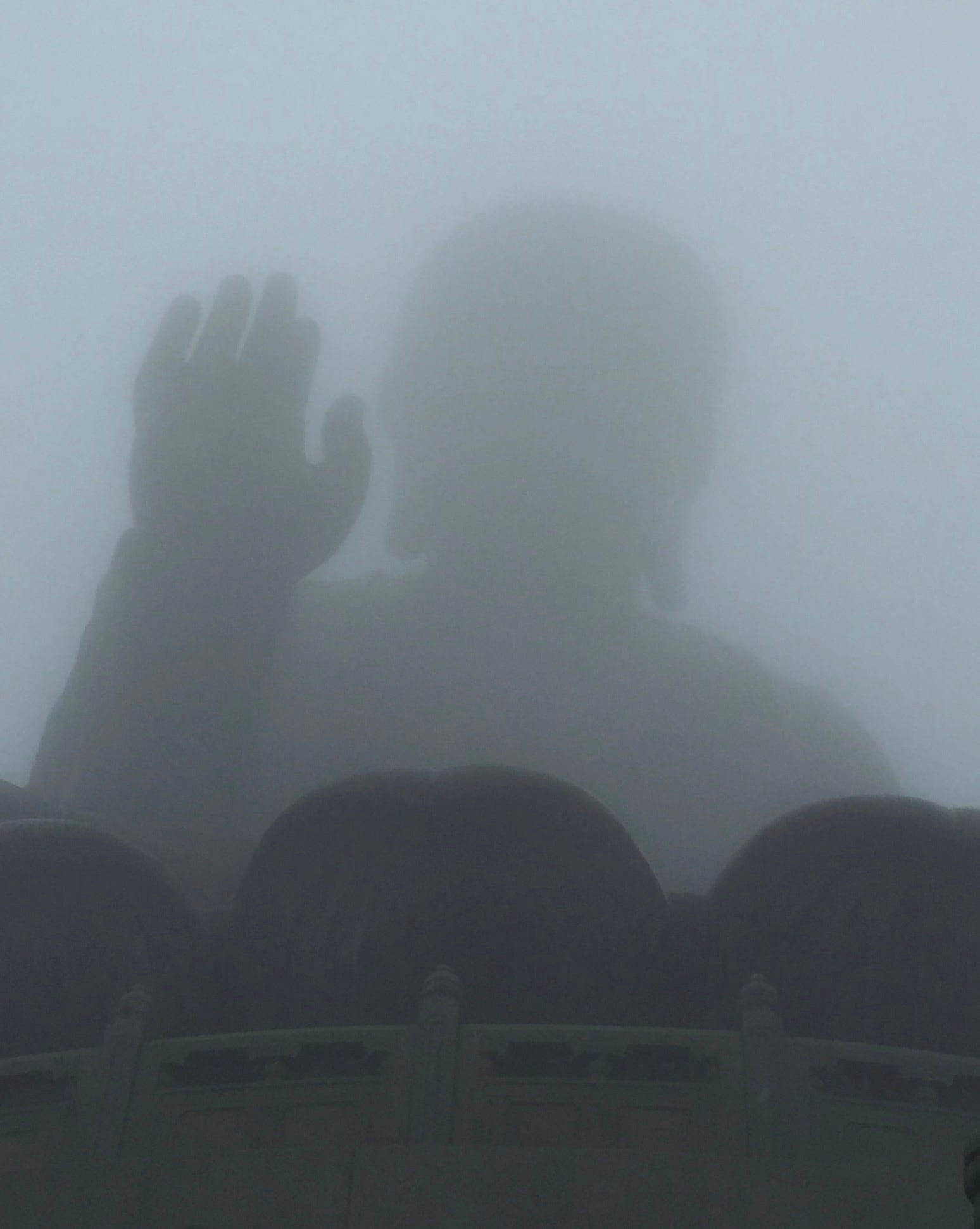
A stiff breeze blew through, scattering the fog, and suddenly, the immense Buddha appeared, his bronze hands positioned in a mudra, a symbolic hand gesture. Briefly, I could make out his right hand raised in protection and blessing, his left open in his lap, a gesture of generosity.
Just for a moment, though. The next brush of wind ushered in another patch of fog, and in a breath, he disappeared again. I waited, but the Buddha remained hidden, my fleeting glimpse having to suffice.
I had always wondered what I missed that foggy day.
Today, the luminous morning light offers an answer. Despite the distance, I can’t resist returning to see how the plateau appears in sunlight; mountains rising behind arched gates and the fierce stone figures, once ghostly and mysterious, now fully revealed.
As it turns out, they have a name after all: The Divine Generals.
Walking through the entry gate, I can’t help but smile at meeting them again. Still imposing but no longer shrouded, these twelve protective deities, or yakshas, have long stood guard over Buddhist teachings and practitioners. Over the centuries, their vigil extended to time itself, with each presiding over two hours of the day in the Chinese Zodiac. Today, they continue to secure the walkway with care, six on each side. One raises a sword in defense, another steadies an ax, and a third lifts a vajra, the indestructible scepter, high above.
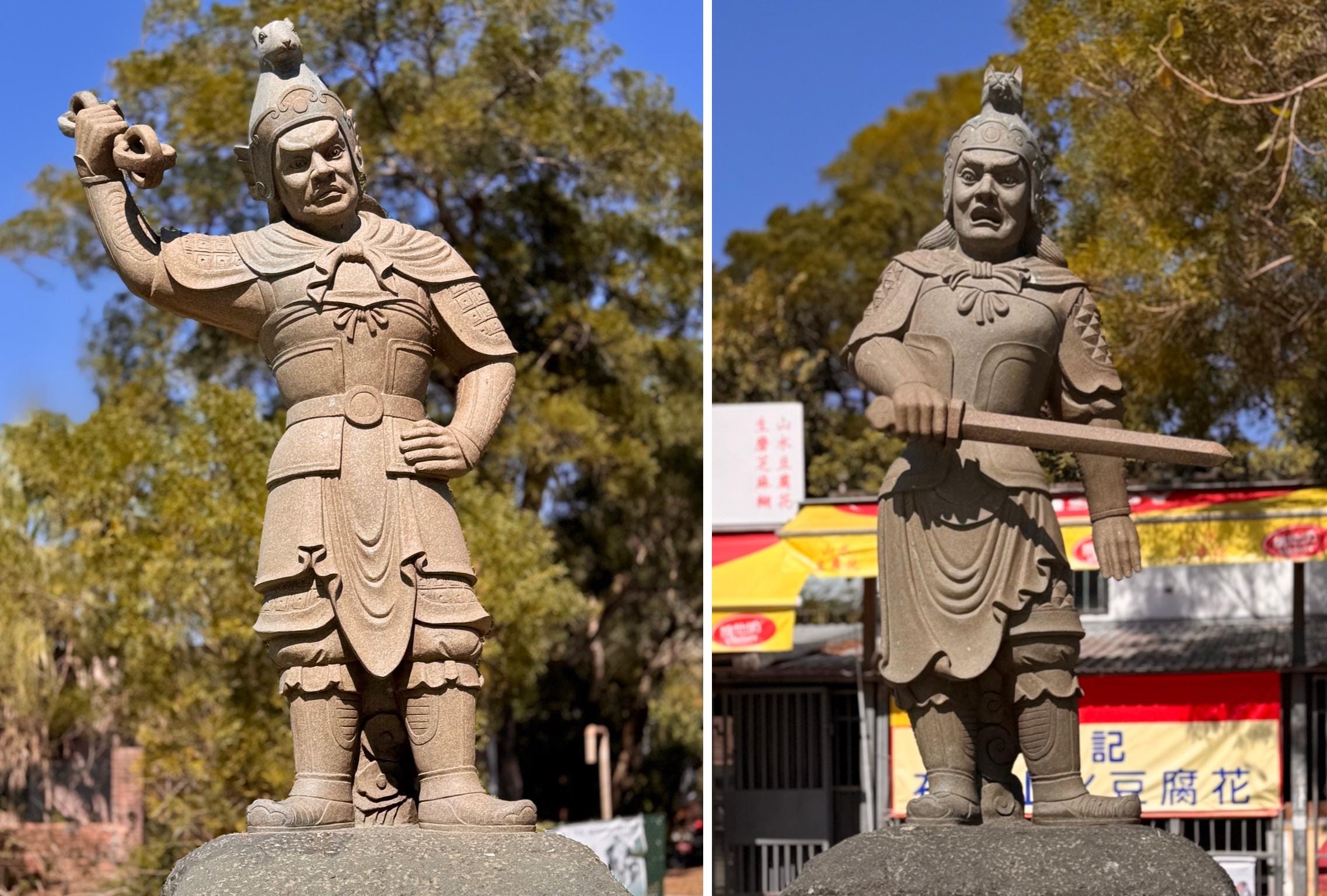
Quietly, I continue past them, noticing that on this clear morning, there are already several tourists here. The Generals, it seems, are too busy for me today.
Arriving at the gate of Po Lin Monastery, what was once a hazy outline shrouded in fog is now clear. White granite forms a three-arched opening, topped with decorative tiers of square blocks called dougong. Further in the background, Lantau Peak rises majestically.
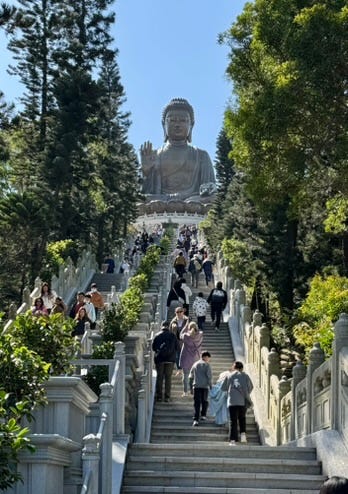
Turning, I notice that the immense Buddha is clearly visible, all the way from the bottom of the long stairs. Climbing to the top, I once again reach the circular path around the base. I can finally see the kneeling female figures, no longer veiled in fog. Representing the Six Perfections, these divas, celestial beings, offer gifts such as flowers, incense, and music; gestures of generosity and wisdom.
An Altar of Heaven, indeed.
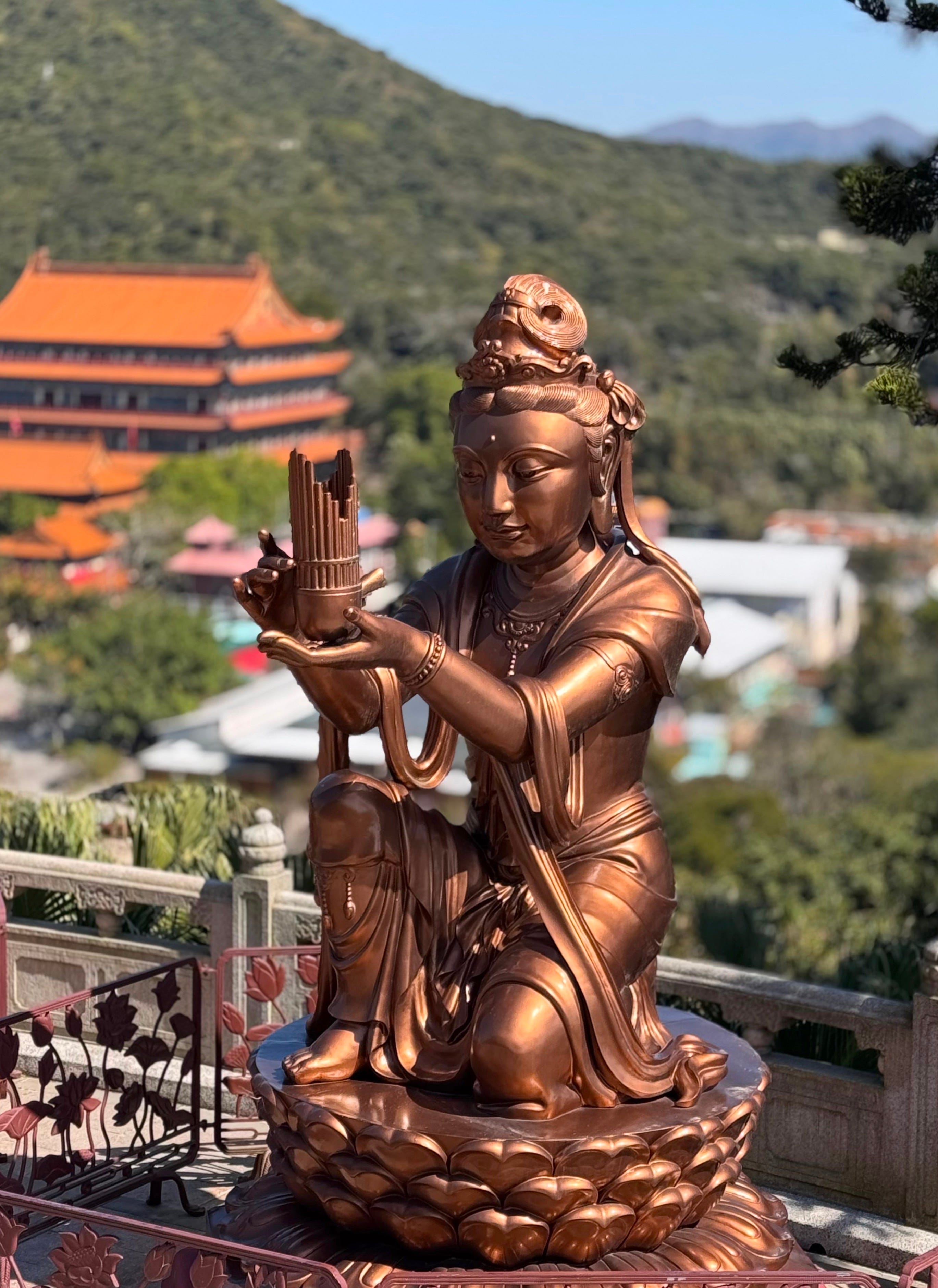
Looking across the forested hills to the ocean beyond, I couldn’t have chosen between my visits. Both were beautiful. Perhaps that’s the point of any journey: the chance to see anew. Fog made the first visit magical: mysterious and hidden. I could have left it there, had I not returned, content with mists and shadows. But on this clear morning, a new kind of magic is in play: the mountains, the Divine Generals, and Tian Tan Buddha stand fully revealed, offering me a closer look and a second chance to see.
It’s an odd way to live life, in this pilot mind of mine: one foot in watchful preparation, the other aware of moments beyond our control. We are well-trained for both. Still, I find myself looking for the bit of magic each flight offers: clear air, a radiant sunrise, or even a familiar city shining in a new light. Of the many lessons this career continues to teach me, balance may be the most significant.
As it turns out, fog is just fog.
Thanks for taking me along the ride with you once again. I get so excited when I see you have posted another adventure. You never disappoint !!
Fabulous! I especially liked "the gentle muffled rhythm of drizzle against my hooded jacket, as it focuses on the sound of rain rather than the feel. Also, "A cow appeared" which, without any explanation, might imply that it appeared by magic or was transported there somehow... Keep writing!@