
Inside Paro Taktsang
Meeting Dorje Drolo

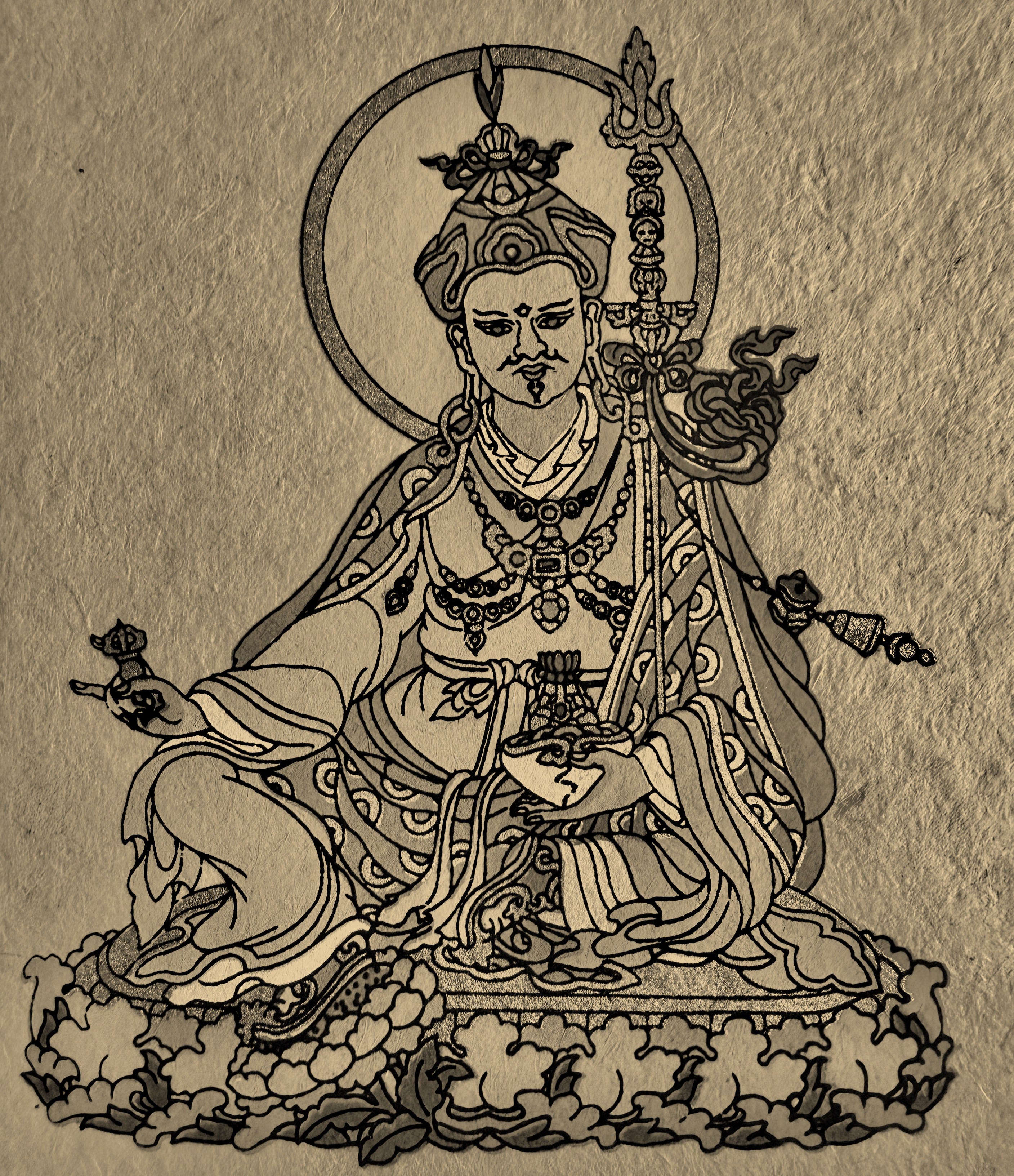
At the heart of this remote Himalayan Kingdom, Padmasambhava remains a living presence.
At first, that name was new to me. Before long, however, it seemed to be everywhere. His image appeared in temples, and guides spoke of him with quiet reverence. Kings, they said, once sought his counsel. I learned of his 8th-century journey from India to Tibet and the path that eventually led him to Bhutan. The stories continued to unfold, following me from valley to valley.
By the time I reached Paro Taktsang, I knew I was climbing toward much more than a sacred monastery. I was climbing toward a world shaped by his presence.
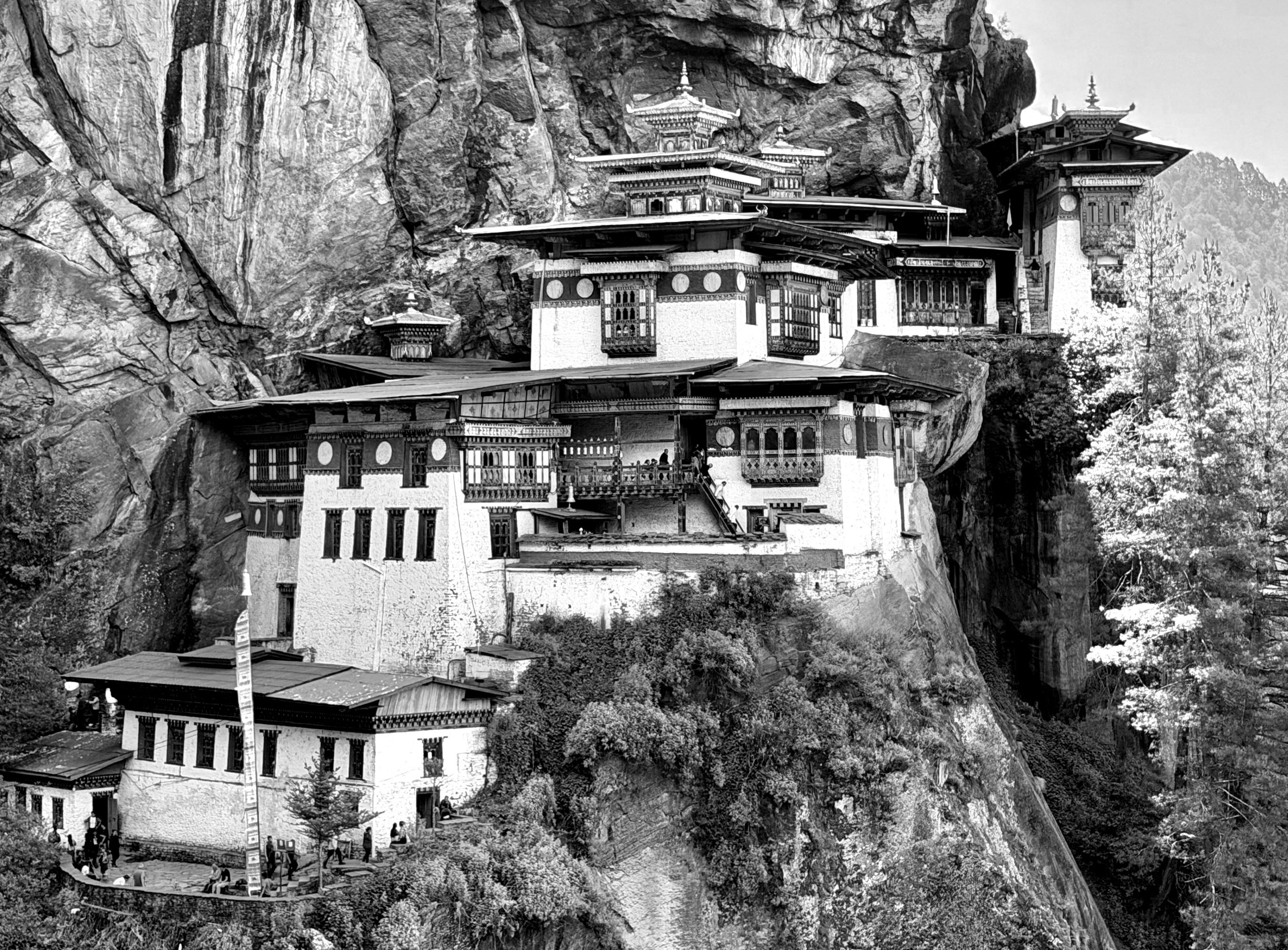
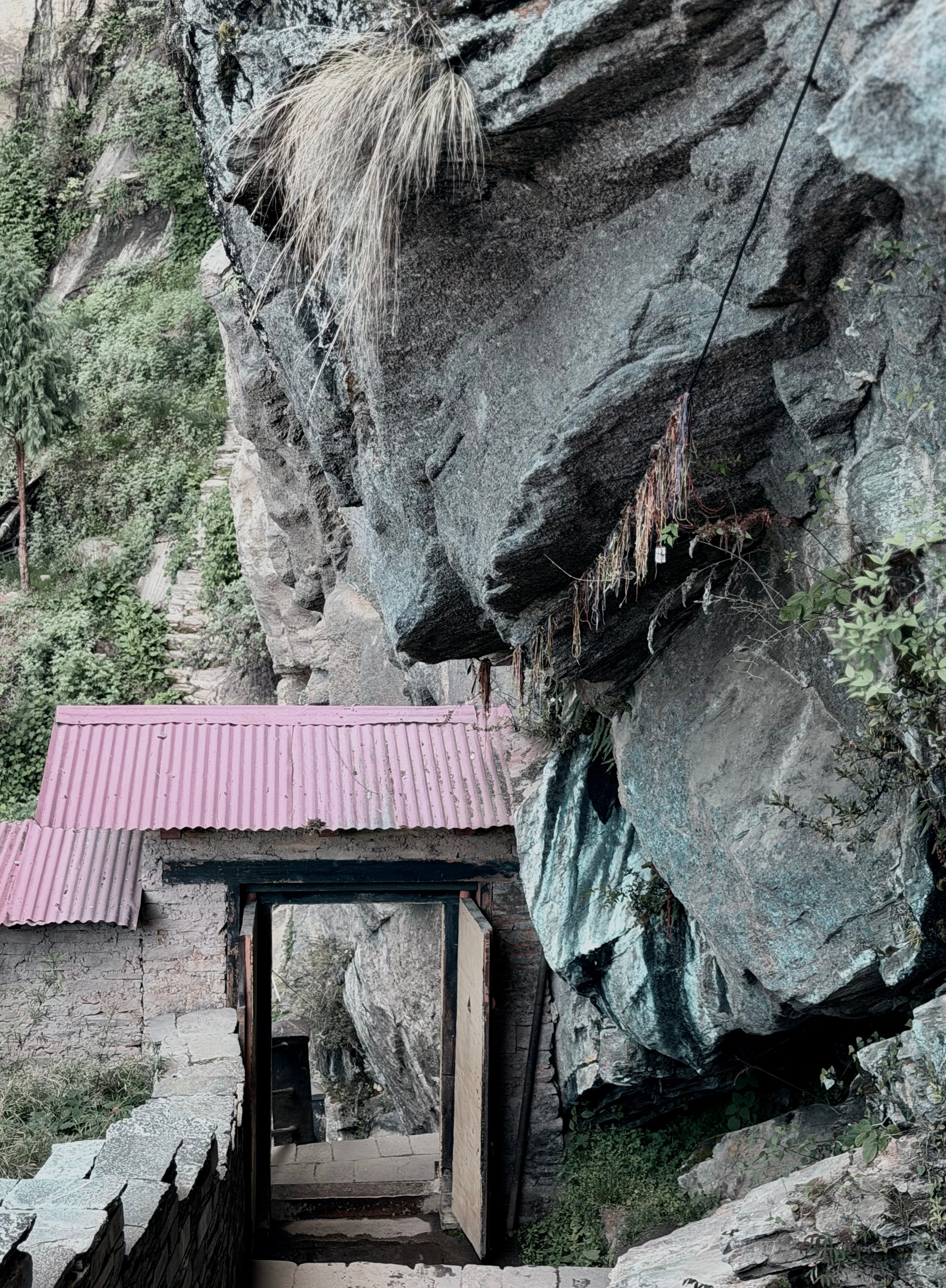
In the early morning, the cliffs are shrouded in fog, granting only glimpses of the buildings tucked deep within the towering rocks. A dog, just ahead, watches as I make my way up the last set of stone steps. On the terrace, cameras, phones, and other electronic devices must be turned in; none are allowed inside.
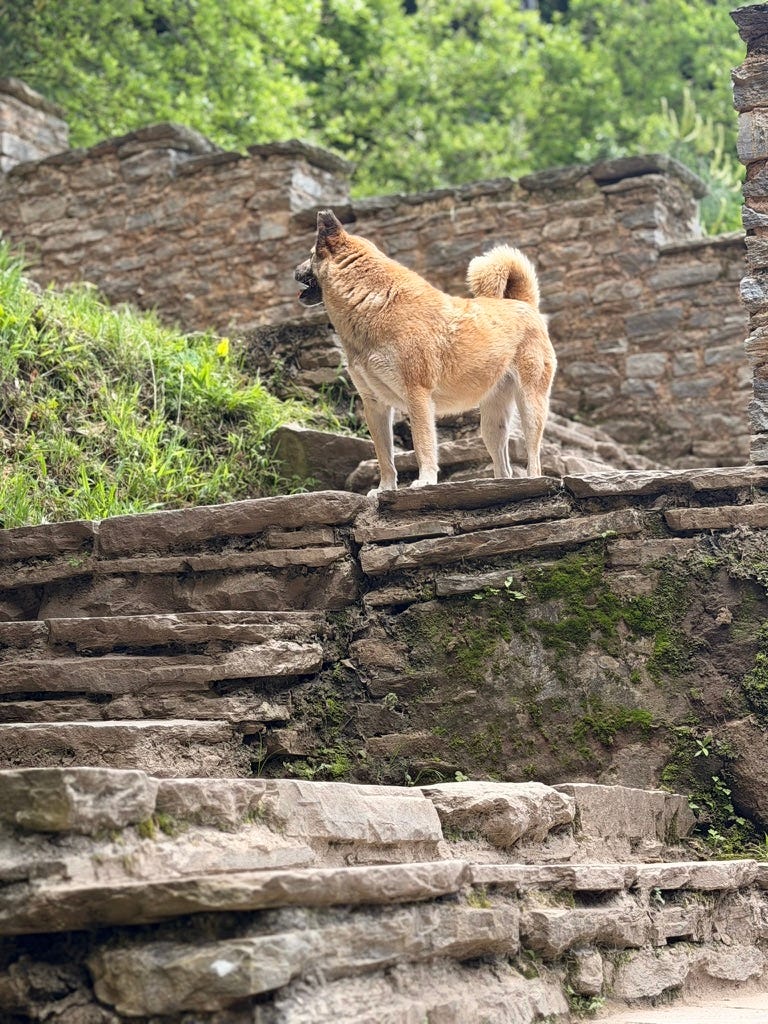
From this point on, my memory will be the only notebook I have.
Through the gate, a monk chants sacred mantras and offers a blessing of holy water. With a blink, I am inside the world of Padmasambhava.
The monastery is only beginning to stir, and the flashes of red I had noticed earlier now show themselves to be robed monks preparing for the day. Due to the early hour, we are the only ones on the stone terrace as I pause to look across the distant valley. It is now another world, far away.
Around the corner, the first doorway awaits me. As I step carefully over the threshold, a wooden sign reads, ‘Temple of Guru Dorje Drolo’. Another name I do not know.
The room is dim, and as my eyes adjust, vivid details emerge around me. There is almost too much to take in: intricate tapestries, carved wood, formidable statues, and flowing ribbons of fabric.
In the stillness, we carefully light a butter lamp, an offering for a life no longer present. Then comes a brief moment to sit, reflecting on wishes that extend far beyond my own limited experience.
Around me, however, there is movement. Monks quietly come and go, their whispers echoing through this small space. I shift slightly to make room as they gather cushions stacked along the wall. Then silence again as they disappear outside.
As I stand to leave, I take a closer look at the imposing statue dominating the room. Wrathful and intense, it is almost overwhelming at first glance. Painted eyes glower with determined ferocity, and suddenly, I am spellbound.
Yet, behind his unrelenting eyes, I sense an aliveness radiating from him with such strength that I begin to see something else glimmering just beyond his formidable gaze.
Fierce compassion. Suddenly, it is unmistakable, so clear that I find myself smiling.
I didn’t understand it at the time, but I had found myself face-to-face with Dorje Drolo, one of the eight manifestations of Padmasambhava. As a teacher, Padmasambhava appeared in different forms, embodying the lesson required: one manifestation to illuminate illusion, another to dispel confusion, and yet another to overcome obstacles.
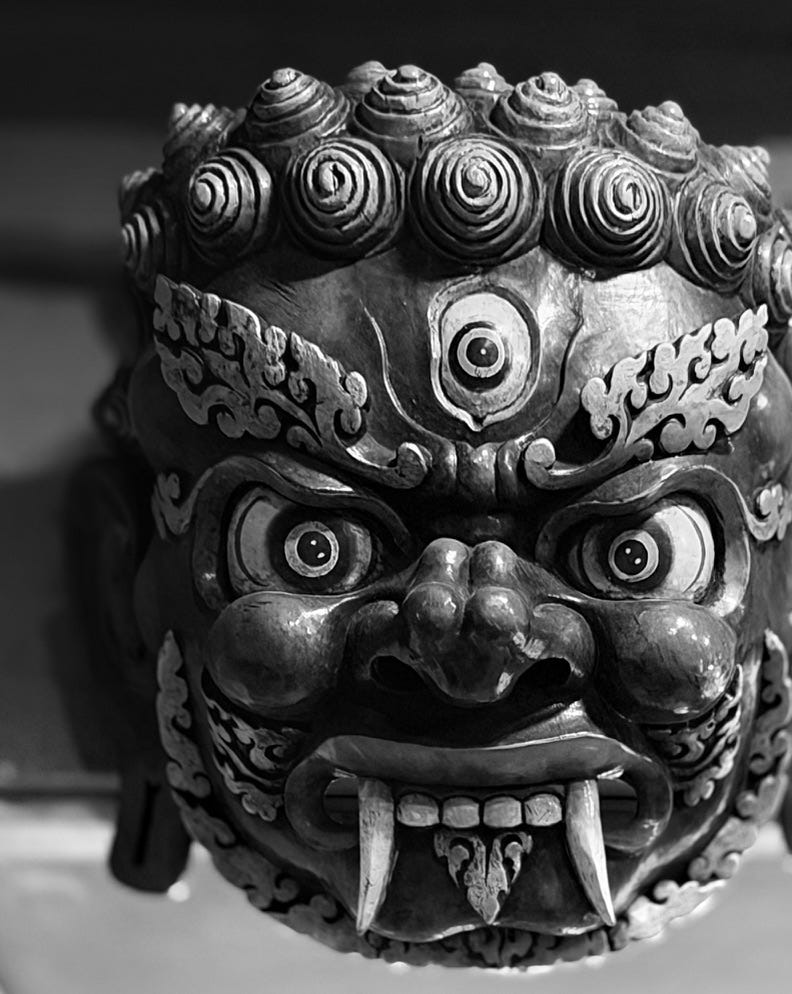
Tradition holds that other deities were present when Dorje Drolo first arrived in this valley. Consumed by their own power and ego, they sought to prevent Buddhism from flourishing. Dorje Drolo faced them, but these are not stories of vanquishment or death. They are stories of hope: powerful forces subdued and destructive energies transformed. It is a timeless expression of compassion, so powerful that the centuries seem to disappear in its wake.
I linger as long as I can, but there is more to explore. Reluctantly, I leave Dorje Drolo behind.
Onto other rooms with darkened wood walls. Exquisitely detailed paintings that flow around me, from one wall to the next and beyond, absorbing me in their stories. Statues of the Buddha that tower above, their brilliant gold swallowing the dim light. Cryptic tales filled with symbols I try to remember.
We are high up in the farther buildings, visiting the remaining areas, when a faint sound of horns reaches my ears. Long brass instruments called dungchens produce a mesmerizing tone that echoes an elephant’s call. I am instantly curious, craving to be in that space.
On the way down, I hear the horns again, louder as I descend. A ceremony is unfolding, and the mystery surrounds me as I arrive on the terrace once again.
In the dim morning light, a fire has been lit, crackling as its smoke curls upward against the sheer granite cliffs. Unexpectedly, I become a witness to prayers being made and deities being honored. But who and why?
A smiling older monk, noticing that I am lingering to the side, motions for me to come closer and sit, then returns to oversee. Gently, he nudges a standing monk into a different position, offering a silent reminder that the flow and pace of the ritual are part of its significance.
Seated on fringed cushions, a row of monks chant in words I do not understand. Vajras and bells. Gyalings, a reed instrument similar to an oboe, resonate across the stone. The rhythmic beat of the drum.
Behind me, another monk explains the ceremony. To my surprise, I hadn’t left Dorje Drolo behind after all. The ceremony was for him.
At the edges, three other monks stand, waiting. A fourth brings items to the monk leading the ceremony, who takes each piece carefully, chanting as he places it on the offering plate. In his other hand, he holds a ritual bell, ringing it at precise intervals.
Every second seems to hold a solemn purpose.
And yet, human moments occasionally break through: I smile as one monk yawns. Another quickly shuffles through the stack of narrow, unbound sheets in front of him, as if he had misplaced the next mantra. Around him, the ceremony continues, unbroken. Strands of grain, fruit, chickpeas, rice, and ghee are offered into the fire, and after each, the air fills with the haunting reverberations of the dungchens.
After a time, I am once again reminded that we must continue on. The descent is steep, and the trip down will be almost as long as the ascent. Rising from my seat, I take a last look and turn to leave.
It is still early, but across the valley, I can see multiple figures moving steadily up the trail, on their way to what I am not ready to leave behind. Down the steps, through the gate, where the monk’s chant lingers for those yet to enter. Behind me, the smoke and incense wane.
The sounds of horns, however, follow me. As I walk, I can picture the fire in my memory and the chanting I no longer hear.
One last burst of the dungchens reaches my ears, fading as I disappear into the canyon below. By the time the trees close around me, their notes are gone altogether. Only the narrow trail remains, leading me back to another world.
i’m sitting here quietly on my deck. It’s early morning and the wind is making our chimes sing softly. I just read your piece and I’m thinking that it’s amazing that there is a world so far away that is not bothered by the drama and tragedy that’s going on in the world in which we live every day. It’s a confusing paradigm or perhaps a dichotomy is a better descriptor. But once again you have given me the ability to transport to someplace so totally different from where I spend my days and it allows me to spend just a few moments imagining something quite different.
How can this little planet hold all these immense worlds? Thank you for taking us on this most fantastic journey.